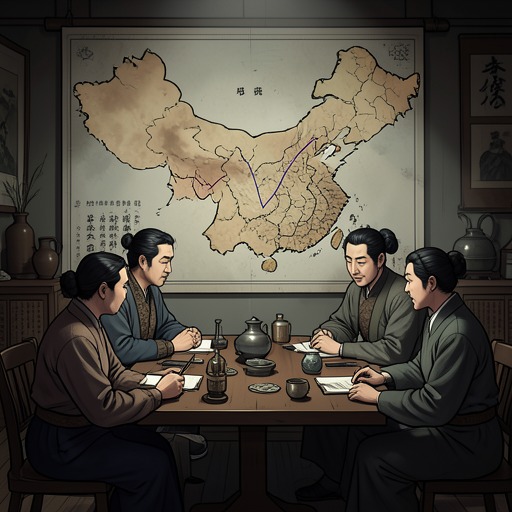
Empires collapse into chaos and empires arise from chaos
The Romance of the Three Kingdoms“Empires collapse into chaos and empires arise from chaos” is the book’s closing historical maxim: it turns the reunification of the Three Kingdoms under Jin into one phase of a recurring cycle, rather than a final escape from political change. The story’s campaigns give that cycle concrete form, showing how rule is contested and overturned through strategic misjudgment, deception, and the material conditions of war.
The Maxim at the Ending
The saying appears as the narrative draws its account of the Three Kingdoms to a close. Jin has made the divided realm one again, and the maxim immediately interprets that result as part of a larger pattern: empires break into disorder, and new empires emerge from disorder. Unity is the outcome of the story’s final political struggle, but the phrasing denies that unity is permanent or self-sustaining.
The surrounding conclusion sharpens the sense of historical succession. The rulers of Shu, Wei, and Wu are said to die naturally in their beds, while the former Wu ruler Sun Hao is received by Jin and granted a minor role. The contrast places individual fates within a change of regime: the kingdoms have ended, their rulers pass away, and the political world that replaces them incorporates some of the defeated order’s surviving people. The maxim supplies the broad frame for this closure without claiming that every transition follows an identical course.
How Power Turns
The episodes of war make the maxim more than a summary of dynastic change. At Wancheng, Jia Xu reads Cao Cao’s attention to the city wall as a possible feint: Cao Cao appears to prepare an attack in the northwest while recognizing that the southeast wall is weaker. Jia Xu advises Zhang Xiu to answer deception with deception, concealing elite troops near the vulnerable side while using ordinary people in armour to disguise the northwest. The episode makes political survival depend on interpreting appearances correctly; a force that mistakes a staged signal for the enemy’s true intention may lose its advantage at the point of entry.
At Guandu, the balance of power is exposed through supplies as well as numbers. Yuan Shao commands a much larger army, while Cao Cao can field only about a tenth as many men. Xun You urges an immediate attack because Cao Cao’s veterans may be able to defeat a larger force, but their limited provisions cannot sustain a prolonged campaign. The confrontation thus turns on a narrow window: numerical superiority does not settle the contest if the larger army’s opponent acts before his own supplies run out.
Strategy, Deception, and Reversal
The book also shows strategic intelligence creating a reversal from apparent weakness. Before the battle at Bowang, Kong Ming assigns Guan Yu and Zhang Fei concealed positions from which they are to strike after a signal of fire; Zhao Zilong is told to feign retreat, while other commanders prepare fires beside the ravine through which the invading force must pass. The plan makes coordination, concealment, and timing the means by which a smaller defending force can confront Cao Cao’s advance. Its success is set against the brothers’ initial skepticism about Kong Ming’s authority and his decision to remain away from the fighting.
During the arrow episode, the same logic of misread appearances is turned against Cao Cao. In dense fog, Kong Ming’s boats approach the north shore, where sailors beat drums and shout as though a large attacking force were landing. Cao Cao orders his archers and crossbowmen to fire into the fog; arrows strike the straw-bale barriers on the boats until the bales bristle with them. Kong Ming withdraws as the fog lifts, carrying away the arrows without a direct battle. The episode makes the opponent’s response—not simply the strength of one’s own force—the resource that determines the outcome.
The defeat at Jieting supplies a harsher counterpoint. Ma Su rejects Wang Ping’s advice to hold the road and instead takes a hill, relying on book learning rather than practical military judgment. Sima Yi exploits the position: Ma Su’s troops are cut off from water, begin to desert, and are driven into a desperate retreat. Wang Ping and Wei Yan attempt to rescue the army, but the Shu forces suffer heavy losses and Sima Yi captures the city. Here, failed judgment turns a defensive assignment into a strategic reversal, demonstrating how quickly an advantage can disappear when command disregards the conditions on the ground.
Historical Meaning
Across these episodes, the cycle is not presented as a mechanical repetition in which every kingdom rises and falls for the same reason. Instead, the maxim gathers distinct causes of change—deception, scarce provisions, disciplined coordination, and errors of command—under a broad vision of political impermanence. Cleverness may win an engagement, yet no single victory guarantees lasting rule; a misread wall, an exhausted supply line, or a badly chosen position can alter the course of a campaign.
Placed after Jin’s unification, the saying also changes the emotional weight of the ending. The realm’s reunion is real, but it is not represented as history’s final condition. The maxim closes the account by holding achievement and vulnerability together: disorder gives rise to empire, and empire remains exposed to the forces that may return it to disorder.